AI is not cutting jobs. It is closing the entry door.
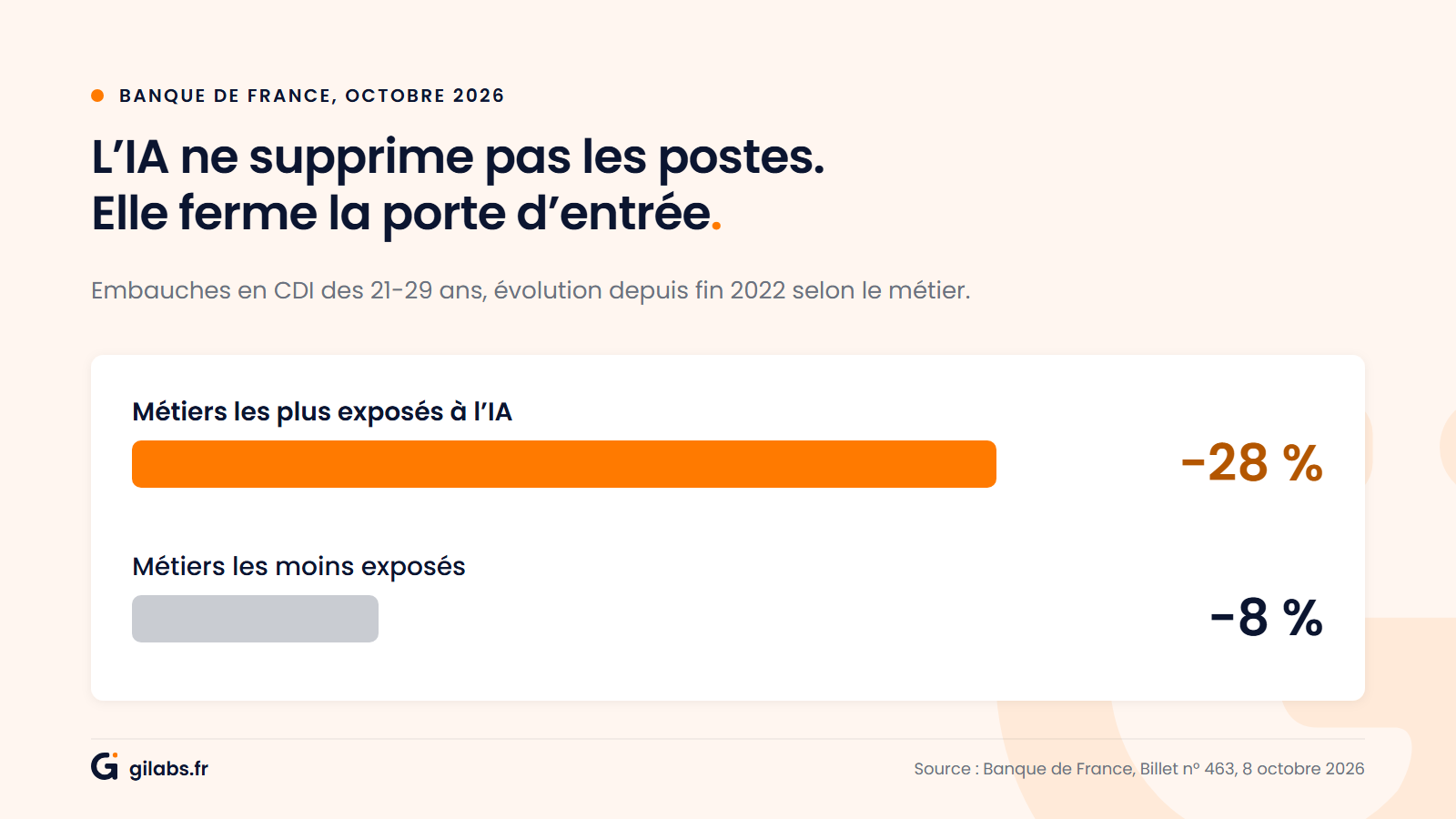
Among 21-29 year-olds in France, permanent hires are down 28% in the occupations most exposed to AI. Total employment has not moved. What it means for an SME.
In 2010, one of my first tasks as a junior developer was writing CSS. Today I hand that task to an AI.
The question that follows is an uncomfortable one: would I have been hired in 2026?
I am not sure. And since 8 October, that is no longer just a feeling.
What the Banque de France measured
Five economists at the Banque de France tracked permanent-contract hires and terminations in France from January 2019 to March 2026. They ranked occupations by their exposure to generative AI, meaning the share of an occupation’s skills that an AI can perform or assist with, then compared the trajectories by age group.
The result is concentrated among the youngest. For 21-29 year-olds, in March 2026, compared with November 2022:
| Occupations most exposed to AI | Least exposed occupations | |
|---|---|---|
| Permanent-contract hires | around -28% | around -8% |
| Permanent-contract terminations | around -23% | around -6% |
The gap in hiring is about twenty points. It narrows for the 30-39 and 40-49 age groups and almost entirely disappears above 50.
The second finding matters as much as the first: total employment is not falling. Across roughly 6,000 firms tracked, nearly 600 of which report intensive AI use, headcount at those firms does not differ in a statistically significant way from the others. Companies are not laying people off. They are hiring fewer beginners and replacing fewer leavers.
In other words, AI is not cutting jobs. It is closing the entry door.
What the study does not say
The authors are cautious, and we should be too.
First, AI is not the only suspect. Monetary tightening and the post-Covid correction in the technology sector have weighed on hiring since 2022, in exactly the occupations most exposed to AI. Remote work, which affects the same categories, is also thought to hurt recruitment for junior tasks. These explanations are not mutually exclusive.
Second, firms’ AI use is measured only at the start of 2026, while the hiring gaps appear several quarters earlier. Heavy AI users may differ from other firms in ways that explain both their hiring and their adoption.
Third, the picture abroad is mixed: a US study finds a comparable decline, a Norwegian study does not detect one, and a Danish study mostly sees tasks being reorganised.
So I take the observation, not the proof: where AI can do a beginner’s work, far fewer beginners are being hired.
What you learn by writing CSS
CSS is one of the things that taught me the job. Not CSS itself. Everything around it.
A simple task given to a beginner is rarely about output. It is a way into the real work: reading what others wrote, understanding where a request comes from, being reviewed, getting something wrong where nothing breaks. The task is the pretext, the learning is around it.
That is precisely what the authors flag at the end of their post. Several recent theoretical papers show that automating the tasks assigned to new recruits can reduce learning-by-doing and, over time, the accumulation of skills. They state that their results do not establish whether this mechanism is already at work in France. But the drop in hiring shows up exactly where you would expect it first.
What this changes for a business owner
My position is blunt: a company that stops hiring juniors is manufacturing its own shortage of seniors.
The short-term arithmetic is rational. If an AI does the formatting, the data entry, the first draft, why hire someone for it? The cost comes later, and no dashboard shows it: in five years, the person who knows your processes inside out will leave, and nobody will have been trained behind them.
Three concrete decisions follow.
- Spot the learning tasks before automating them. In a process map, some steps are slow and worthless. Others are slow because that is where newcomers learn. The two should not be handled the same way.
- Move the learning instead of removing it. If the AI writes the first draft, a beginner can learn by reviewing it, provided a senior reviews their review. Checking what an AI produces requires knowing what it gets wrong without saying so.
- Write down what is written nowhere. A process that lives only in a senior’s head is already a risk. Without a successor, it becomes a single point of failure. One more reason to map before automating.
The takeaway
The Banque de France figures describe companies adjusting quietly, through the hires they do not make. That is exactly what makes the subject easy to ignore.
AI does the junior’s work. It will never become your senior.