We rolled out Copilot, and nothing changed in the accounts
Copilot speeds up the person. What a process costs is elapsed time, not hands-on time. Here is how to measure both, and why it decides your AI budget.
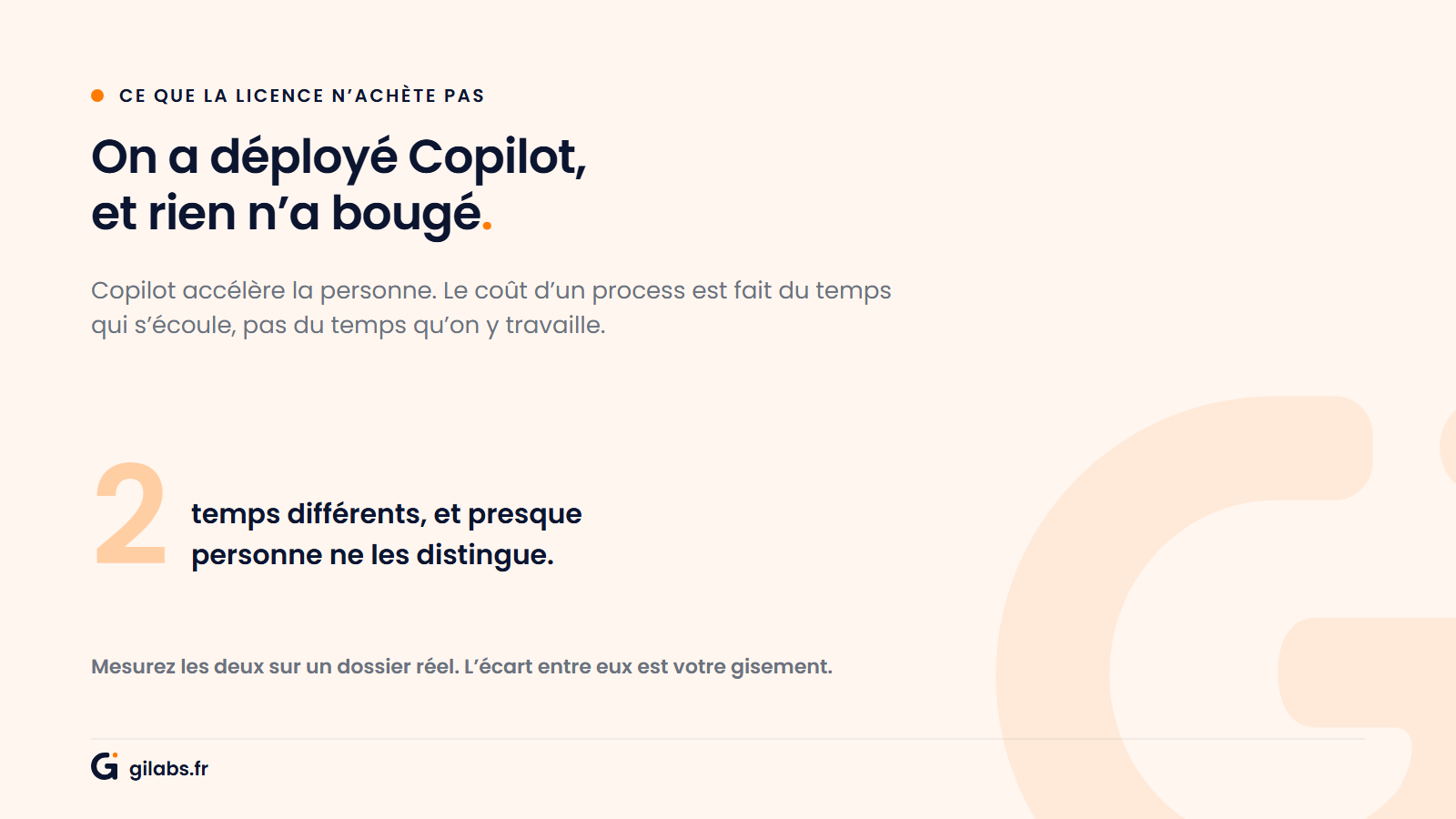
“We rolled out Copilot a year ago. People use it every day. And honestly, I see nothing in the accounts.”
It always comes out as a disappointment, sometimes as a confession. It is neither. It is a perfectly logical outcome, and it can be demonstrated in three minutes from two measurements that almost nobody tells apart.
Copilot does exactly what it promises
It speeds up the person. Drafting an email, summarising a meeting, formatting a document, finding a file nobody remembers the name of. On those gestures the gain is real, immediate, and your teams will not go back.
This is neither a gadget nor a fad. It is a very good tool inside its own perimeter.
The problem lies in what people expect that gain to do.
Two kinds of time, and almost nobody tells them apart
What a process costs is not the time spent working on it. It is the time that elapses.
Take a customer file at your company, from first contact to invoice. Ask how long it takes to come out: the answer will be in days, sometimes weeks. Now ask for the actual hands-on work inside it, the hours during which someone genuinely has that file in front of them. You will get a number with no relation to the first one.
Everything else sits between the two:
- the missing document you have to ask for again, and the three-day round trip that follows
- the approval sleeping in an inbox because that person was in meetings
- the batch processed on Thursday, because Thursday is batch day
- the re-keying from one system into another, waiting for someone to have a spare hour
- the check nobody performs, until an error forces a full redo
None of those five lines gets faster because someone types faster. They are not made of typing, they are made of waiting. That is why a Copilot rollout can be an adoption success and an economic non-event.
It is not the tool’s fault, nor your teams’, nor your IT department’s. It is a mistake about what actually costs money in a process.
What actually moves a lead time
Three levers, and none of them is sold as a licence.
Remove a step. In nearly every process I map, some steps exist that nobody can justify any more: a check that duplicates another one, a spreadsheet nobody reads, an approval introduced after an incident that was fixed years ago. A removed step costs nothing, never breaks, and needs no automation budget.
Connect two systems. Most waiting comes from data that has to travel through a human being to move from one tool to another. As long as that transit exists, it creates a queue, and a queue creates a lead time.
Decide what fires automatically. Not everything, and not carelessly: what runs on its own, under which conditions, and what happens when the system is not confident. That is where AI belongs, and it is a governance decision before it is a technical one.
The honest part of the argument
Sometimes the answer really is Copilot.
When the pain is genuinely about office work, when what costs money is indeed drafting and formatting time, a well deployed and well supported licence is the right call, and I say so. A diagnostic is also there for that: to tell you when the tool you already own is enough.
What I refuse to do is let anyone believe that a licence solves a process problem. It never has, and it will not start doing so with the next generation of models.
The question to ask before any AI budget
It is not “Copilot or not”. It is: on that file that takes three weeks to come out, where did the three weeks go?
Measure both on a real case: end-to-end duration, and hands-on hours inside it. The gap between the two is your opportunity. Until someone has that number, no AI budget can be arbitrated, because nobody knows what it is supposed to reduce.
That is precisely what the 30-day AI diagnostic produces: your processes mapped, the real end-to-end lead time of each one, and a return quantified in euros for each priority case. Along with the list of steps you can simply stop doing.