Case study · industry (anonymised)
Document AI pipeline: manual re-keying eliminated
In an international industrial group, two people re-keyed hundreds of timesheets by hand every month. Today, AI reads the documents, a human validates by batch, and the data flows straight into the business database.
The context
An industrial group operating internationally, with field teams producing hundreds of paper timesheets every month, scanned and processed at head office. The IT system rests on the Microsoft ecosystem: SQL Server database, .NET business applications, network folders.
The problem
Two people were tied up full-time re-keying these documents into the system: slow, thankless work and a source of errors (duplicates, half-finished entries, discrepancies discovered weeks later). Business growth mechanically made the load worse.
The solution, step by step
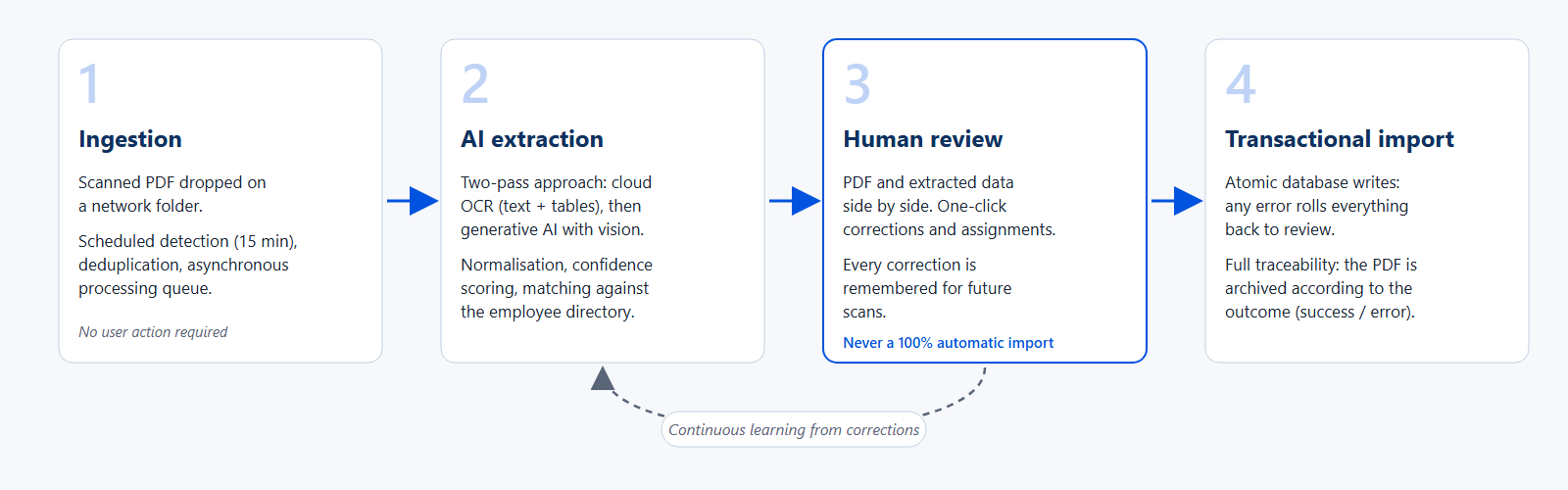
A complete pipeline, built into the core of the existing IT system, without changing the field teams' tools.
-
Automatic ingestion
Scans dropped into the network folders are detected and picked up with no manual step: the pipeline's entry point is the gesture the teams already made.
-
AI extraction
Azure Document Intelligence and an LLM read each document: fields, hour tables, handwritten entries. The group's business rules validate the consistency of every extracted value.
-
Human review by batch
AI proposes, humans decide: a purpose-built validation interface presents extractions by batch, flags doubtful cases, and learns from corrections. Quality improves with use.
-
Transactional import
Validated data lands in the business database in a single transaction: zero duplicates, zero half-finished entries, full traceability from document to database record.
The results
- ≈ 2 full-time roles of re-keying redeployed to higher-value work
- Data-entry errors all but eliminated, full document-to-database traceability
- Built in .NET inside the existing estate: pipeline, validation interface, business rules
- The system learns from corrections: quality improves with use
- No disruption for field teams: same scans, same network folders