My AI made up a price. My rule fits on one line.
An AI read a free credit as a price, with no warning at all. What that near miss says about the framework a small business needs to use AI.
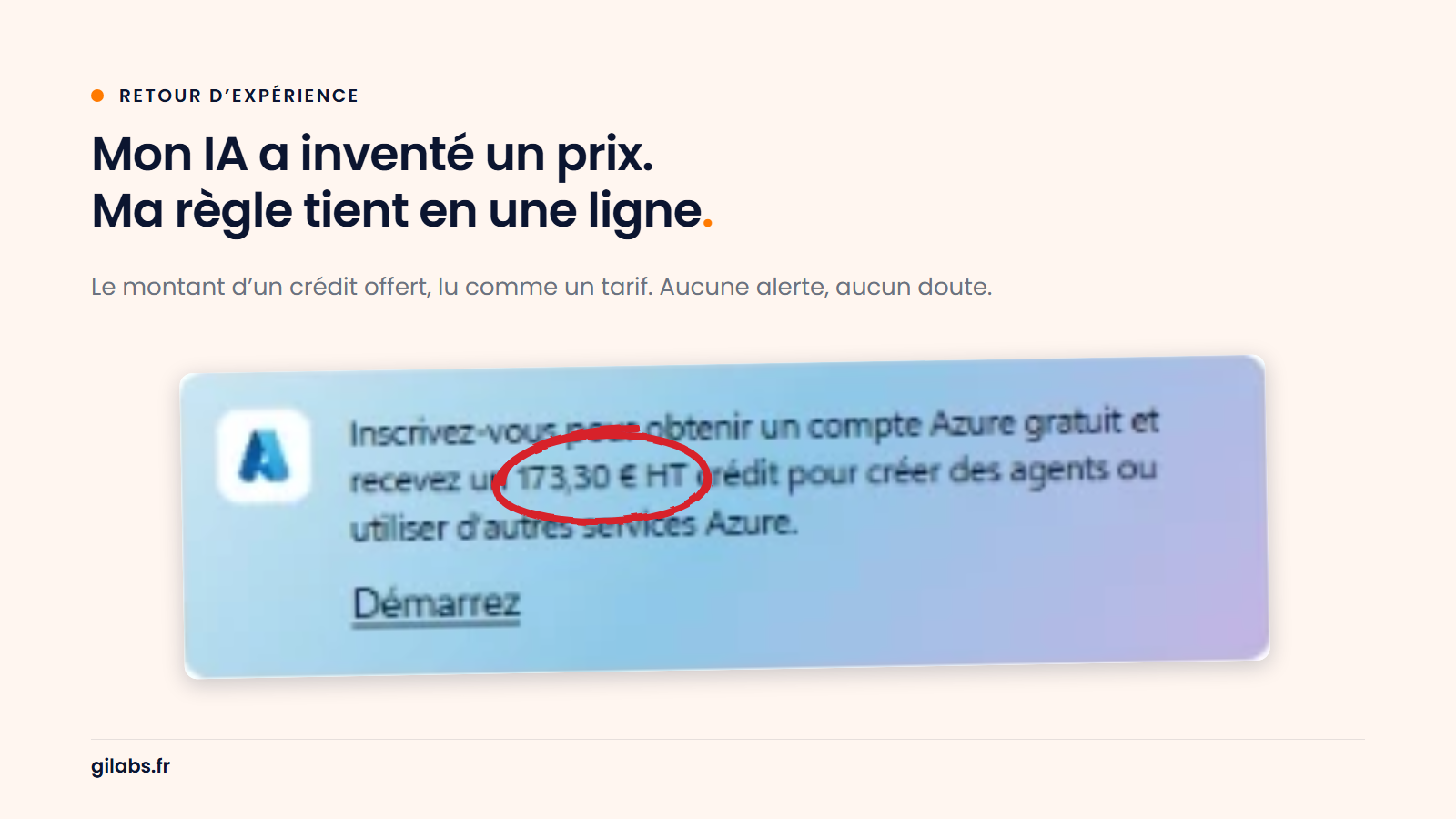
In early October I was writing a guide comparing Copilot and custom AI. A guide like that contains prices, and I use an AI to help me read vendors’ pages.
It read Microsoft’s pricing page and handed me a price: 173.30 euros.
It was not a price. It was the amount of a free credit, shown in a banner on the same page.
What happened
The page shows three plans side by side. Under two of them, a banner offers a free Azure account with a credit of 173.30 euros excluding tax. The amount is written like a price, in the same format and the same currency as the prices above it.
The AI summarised the page, and in its summary that amount became the price of a pack. The sentence was well formed, consistent with the rest, entirely plausible.
I noticed because I had got into the habit of checking prices against screenshots of the page. The figure matched none of the three plans. Without that check, it would have gone live in a guide I present as verified at the source.
The same day, the same mechanism produced a second error: a deadline in the EU AI Act dated 2024 instead of 2026.
Why this is the most dangerous kind of error
What struck me was not that the AI got it wrong. It was the shape of the answer:
- no warning
- no doubt
- a clean sentence that was false
Conventional software that fails tells you so: an error message, an empty field, a red screen. A language model always answers. When it is wrong, the answer looks exactly as it does when it is right. Nothing separates the two on reading.
And the error had an understandable cause. The amount really was on the page, written like a price. A reader in a hurry could have made the same mistake. The AI did not conjure a figure from nothing, it attached a real figure to the wrong thing. Those are the hardest errors to spot, because a quick check (“is this number actually on the page?”) confirms them.
A rule, not a policy
Since then, my rule fits on one line: a figure is published only after the source has been read by eye. It applies to prices, dates and percentages. It was applied to this article too: the figure below was reread on Coface’s own page.
According to the 2026 Data & AI Barometer by Coface and Les Echos Études, a survey of 900 French decision-makers, 60% of companies have no formal framework for their use of AI. In detail, 35% have nothing in place and no plan to change that, and a quarter are thinking about it without having written any rules.
The usual response is a policy: a ten-page document, approved by management, that nobody rereads. I argue the opposite. One short rule that is applied beats a complete policy that is ignored.
A good rule has three properties:
- It comes from a real mistake. Mine comes from a false price, not from a general reflection on AI risk. That is why it sticks.
- It sits where a mistake is expensive. An internal draft can carry an approximation. A published figure, an amount sent to a client, a date in a contract cannot.
- It names an action. “Be careful” is not a rule. “Reread the source by eye before publishing” is one: you know whether you did it.
It is the same logic as AI proposes, deterministic logic disposes: the AI produces, an independent check validates, and that check does not rely on the AI itself. Asking the model whether it is sure does not count as a check.
In a company, these rules are written process by process. The question to put to each team is not “do you use AI?” but “at what point does something produced by AI leave the building without anyone having reread it?”. That is where the first rules belong. Unframed individual use makes those points invisible, which is exactly the problem.
The takeaway
I did not stop using AI to read pages. I stopped publishing what it reads without rereading it myself.
AI never doubts. That part is yours.
Sources and references
- AI in business: usage is growing, governance is lagging (2026 Data & AI Barometer, 5 October 2026, in French) Coface, with Les Echos Études