AI proposes, deterministic logic disposes: the pattern that keeps AI production-ready
AI in production is not AI that decides on its own. It is AI that proposes, to a system that has the right to say no. The three-layer architecture pattern behind it.
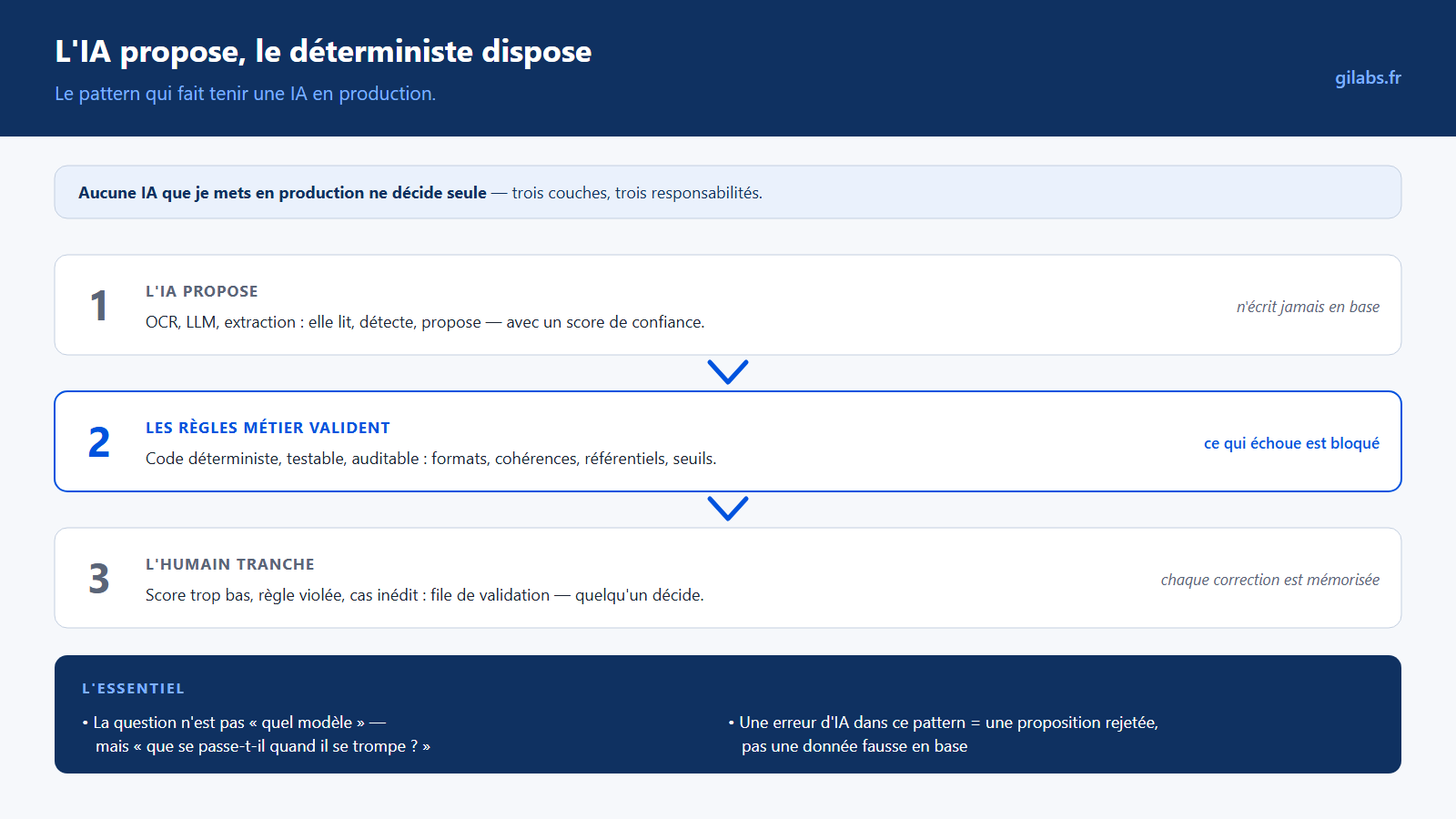
AI in production does not decide. It proposes, to a system that has the right to say no. Every AI system I have put into production shares this same three-layer pattern.
The three layers of the pattern
AI proposes. OCR, a language model, extraction: it reads the document or the input data, detects, extracts, and attaches a confidence score to every proposal it makes. It never writes directly to the database.
Business rules validate. A deterministic layer, made of ordinary code, testable and auditable, checks every proposal the AI makes: expected formats, consistency against existing reference data, business thresholds. What passes these checks gets accepted. What fails is blocked before it reaches the system.
A human decides. A confidence score that is too low, a business rule that gets violated, a case never seen before: the proposal goes into a validation queue, and a person decides. Every human decision is stored and fed back into the system, which improves with use this way, without heavy model retraining.
What this pattern actually changes
In this architecture, a model’s hallucination is no longer a diffuse, uncontrollable risk. It is an explicitly handled case. An AI that gets something wrong becomes a proposal rejected by the validation layer, never wrong data reaching a production database directly.
This is exactly how the document pipeline I delivered in a demanding industrial context runs day to day. It holds up over time not because the AI never makes a mistake, but because its mistakes structurally have nowhere to go without passing through a check.
A detail that is not really a detail
In a system like this, the part actually occupied by artificial intelligence is small. Everything that makes the system trustworthy comes down to ordinary software engineering: tested .NET code, a structured SQL database, explicit business rules, automated tests.
The question worth asking
I am often asked which model I use for a given project. That is almost never the most useful question. The question that actually matters is: what happens when this AI gets it wrong? If the answer is not clear before the first deployment, the system is not yet ready for production.