Zero human validation, and that is the right call: the Convention Online AI chain
One pipeline requires human validation at every step. Another one runs all night with nobody watching. How to decide where to set the dial, based on the real business stakes.
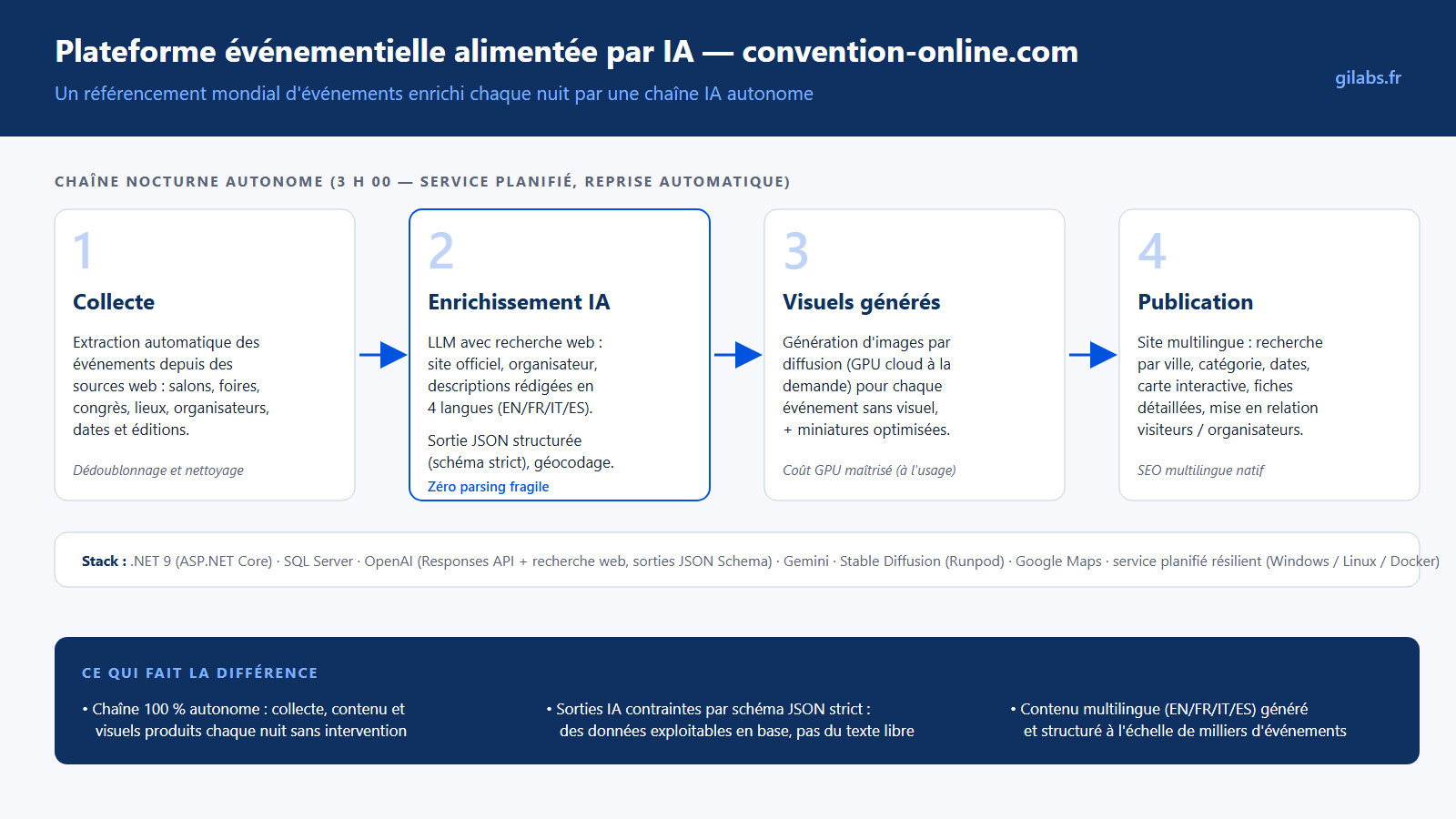
One document pipeline I delivered requires systematic human validation before anything gets written to the database. Auditability demands it: an error on a timesheet that feeds into payroll is expensive. Here is the other extreme, by deliberate design this time: convention-online.com, a worldwide directory of professional events whose entire content is produced by a fully autonomous AI chain, with no human involvement.
What runs every night, with nobody watching
Every night, four things happen with no human intervention at all:
- Professional events are collected from the web, with automatic deduplication and cleanup.
- A web-searching LLM enriches each entry: identifying the official site and organizer, writing descriptions in four languages (English, French, Italian, Spanish).
- Missing visuals are generated by an image model, on on-demand cloud GPU, with no dedicated infrastructure to maintain.
- Everything is published to a multilingual, SEO-optimized site, updated continuously.
The whole chain runs on a resilient scheduled service: if something fails, it resumes on its own, without intervention.
The real decision was not technical
The question that actually shaped the architecture was not “which model to use” but: what happens if the AI gets it wrong?
On timesheets that feed into payroll, a mistake is costly and propagates. The answer is simple: a human validates, always, no exceptions.
On an automatically enriched event listing, a mistake gets corrected on the next pass, with no serious consequence. The answer becomes: it is fine to automate 100% of it.
Same underlying technology. Opposite business stakes. Therefore opposite architecture.
Industrializing AI is not a single dial
This, to me, is where the real difference lies between an isolated AI project and a successful AI transformation: it is not about automating everything, nor about requiring validation everywhere on principle. It is about setting the dial correctly, business case by business case, based on the real cost of a mistake.
This is exactly the work I do ahead of every automation engagement: mapping the processes, identifying where a mistake is expensive and where it barely matters, then sizing the level of human validation accordingly. The outcome is never a binary choice between “fully automatic” and “fully validated,” but a precise calibration, process by process.