I built an AI agent for my own prospecting: here is where it gets it wrong
An n8n agent sourced, enriched and scored my prospects every morning. What it taught me best was one concrete case where a confident AI can be completely wrong.
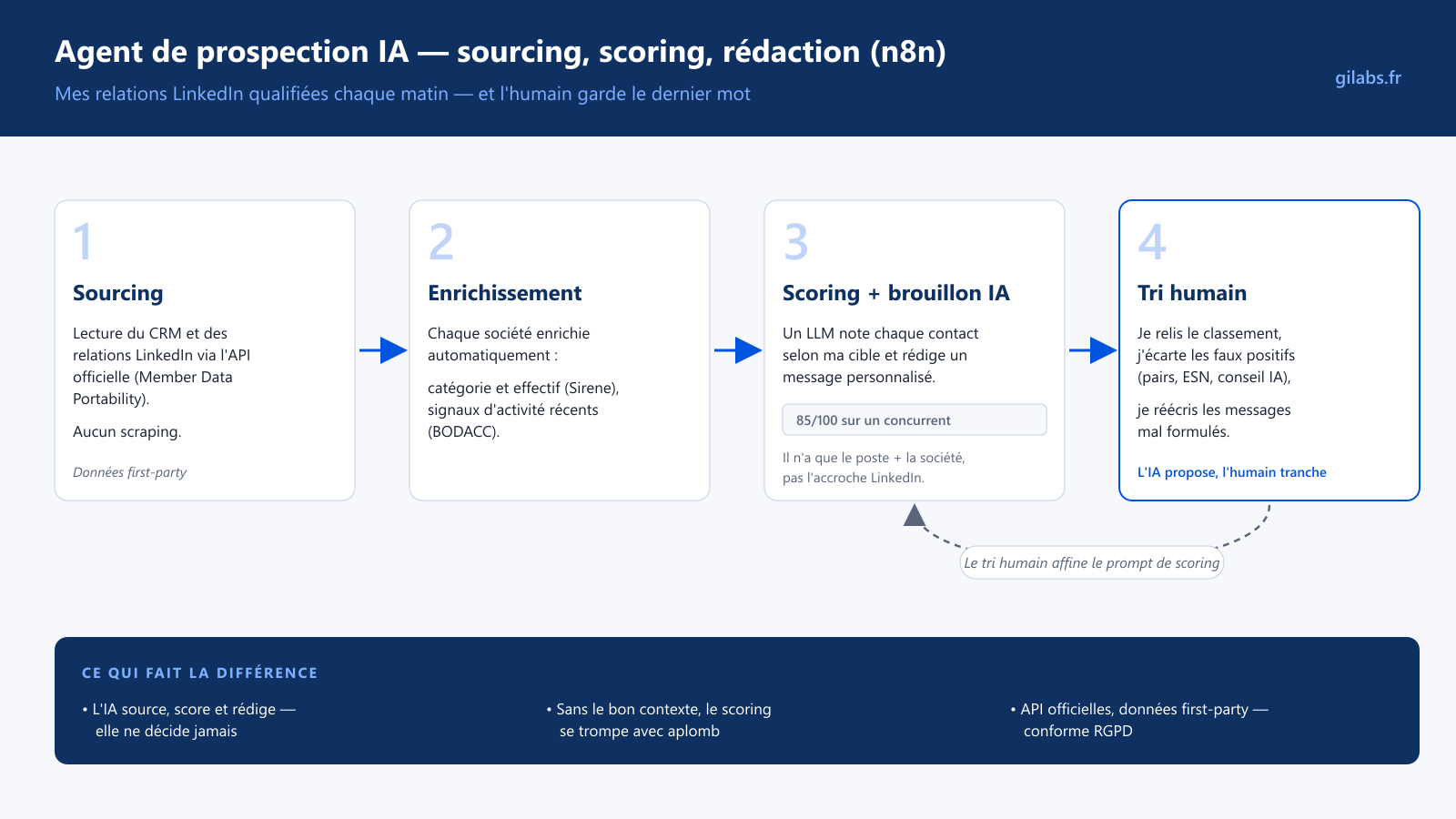
Documenting my AI systems in production sometimes means documenting my own tools. Here is one I built for myself: a prospecting agent meant to save me time every morning. What it taught me best was not what it automates well, but one specific place where it gets things wrong, confidently.
What the agent does, every morning
Running on n8n, the agent operates on its own through four steps:
- It reads my CRM and pulls my LinkedIn connections through the official Member Data Portability API, with no scraping involved.
- It enriches each company with public data (the French business registry, activity signals from official insolvency filings).
- It scores each contact with a language model, based on my prospecting target.
- It drafts a personalized outreach message for each contact it keeps.
On paper, all that was left for me to do was review and click send.
Where the AI got it wrong, with confidence
The scoring model only received the contact’s job title and company name, not their LinkedIn tagline. The result: it ranked profiles who do exactly my job at the top of the list, scoring them 85 out of 100. IT service companies, AI consulting firms.
My “best prospects,” according to the score, were in fact my direct competitors.
Without the right context, AI does not fail quietly. It fails confidently, displaying a score that inspires trust while resting on nothing relevant.
What this changed in how I work
Since noticing this, I now systematically review the top of the ranking before sending anything. I manually remove profiles that have no business being there. I rewrite the messages the AI drafts poorly.
It is the same lesson I keep finding across my other AI systems in production: artificial intelligence does not remove the need for human judgment, it moves that judgment to exactly the point where it matters most. Industrializing AI is not about trusting it everywhere. It is about knowing precisely where it fails, and keeping a human in control at that exact point.
The real fix was not the AI, it was the method
This case also illustrates why I always start an automation project by doing the process by hand, before writing a single line of automation. It was by observing my own sorting criteria manually that I spotted what the scoring model could not see. I go into this build method in detail in a dedicated article.