Garry Tan's AI software factory: the lesson is not in the tools
Y Combinator's president published his method to "ship like a team of twenty." The real lesson is not in the 30 tools he shares, but in the process they run on top of.
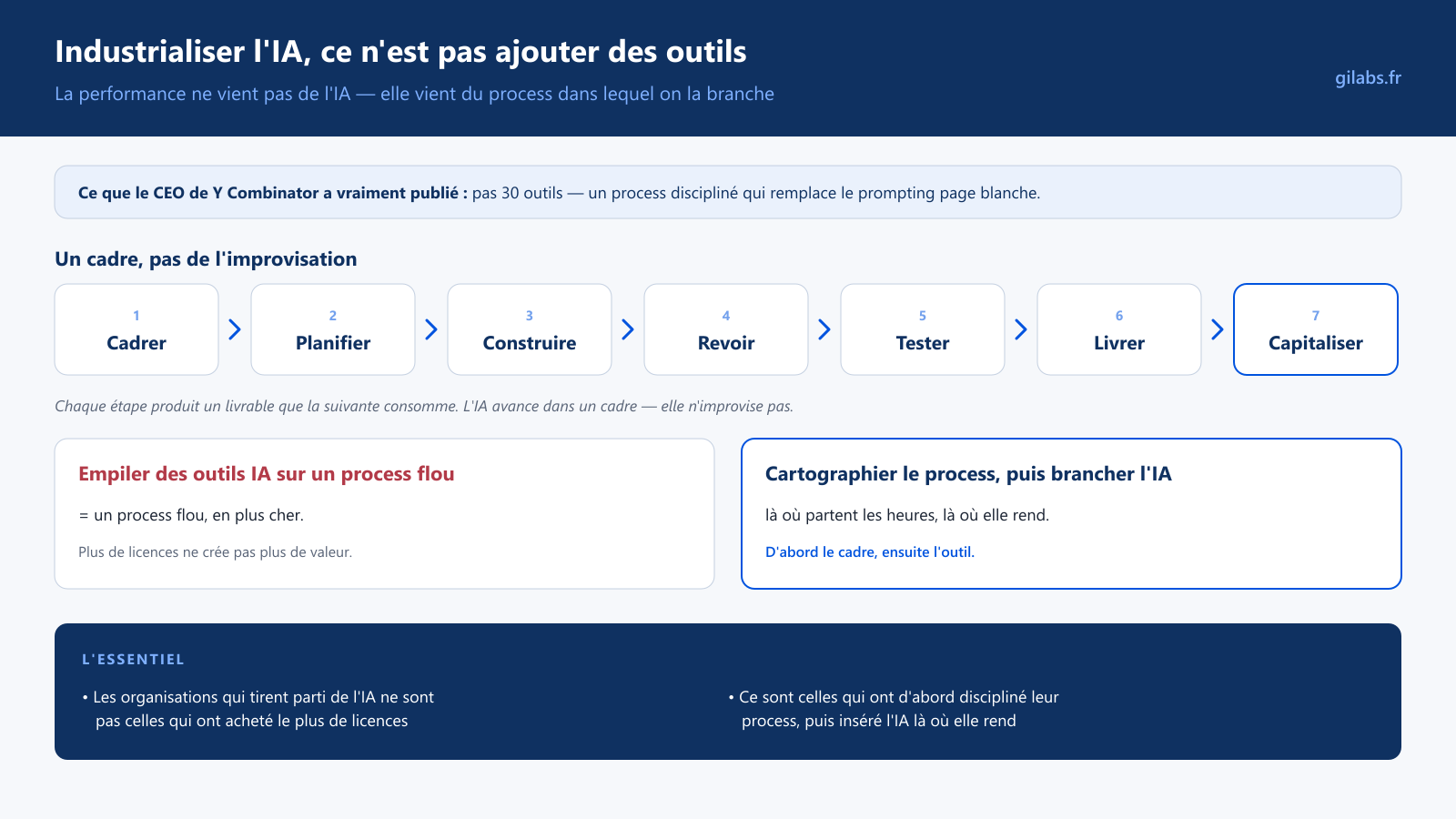
Y Combinator’s president, Garry Tan, published an open-source “AI software factory”: about thirty commands that turn a coding assistant into a full engineering team, with a role that challenges scope, an architect, a designer, a tester, a security lead. The natural instinct is to look at the list of tools. The real subject lies elsewhere.
What he actually built
What Garry Tan put together does not replace a prompt with a better prompt. It replaces blank-page prompting with a structured process:
- Think, then plan, then build, then review, then test, then ship, then capitalize on what was learned.
- Every step produces a concrete deliverable (a design doc, a test plan, a review) that the next step consumes directly.
- The AI no longer improvises on each prompt: it moves forward inside a framework that structures its work.
In other words: performance does not come from the AI itself. It comes from the process it is made to work within.
What I see, engagement after engagement
This is exactly what I observe with clients. The organizations that actually get something out of AI are not the ones that bought the most licenses or tried the most tools. They are the ones that first mapped their process: where the hours go, which step produces what, who validates what, before wiring AI onto that already-clarified framework.
Stacking AI tools on top of a fuzzy process does not produce an efficient process. It produces a fuzzy process, more expensive, with an AI layer bolted on top.
Discipline first, automate second
Industrializing AI is not about adding tools one after another and hoping for a cumulative effect. It is about disciplining an existing process, often by first making it work correctly by hand, then inserting AI exactly where it earns its keep. I go into this method, as I apply it on engagements, in an article on the concierge-first, code-second approach.
The good news in all this: mapping a process before touching it is an exercise any SME can do, with no prior technical skill required. It is even the most cost-effective first step, before considering a single line of code.