40% of French small businesses use AI. Where do you actually start?
Four in ten French small businesses use AI, mostly to write. One in ten automates a task. What the France Num 2026 survey says about the right starting point.
Last month, at a networking evening, someone told me: “our management wants to get into AI, but we don’t know which end to pick it up from.”
I first took it as one company’s situation. Then the France Num 2026 survey came out, and it tells the same story across more than 9,000 businesses.
What the survey says
France Num is the French government’s programme for the digital transformation of very small, small and medium businesses, run by the Direction générale des Entreprises. Its annual survey, published on 28 September 2026, produced the figure that made the headlines: 40% of these businesses now use an artificial intelligence solution. That is 14 points more in one year. Among SMEs, the share reaches 53%.
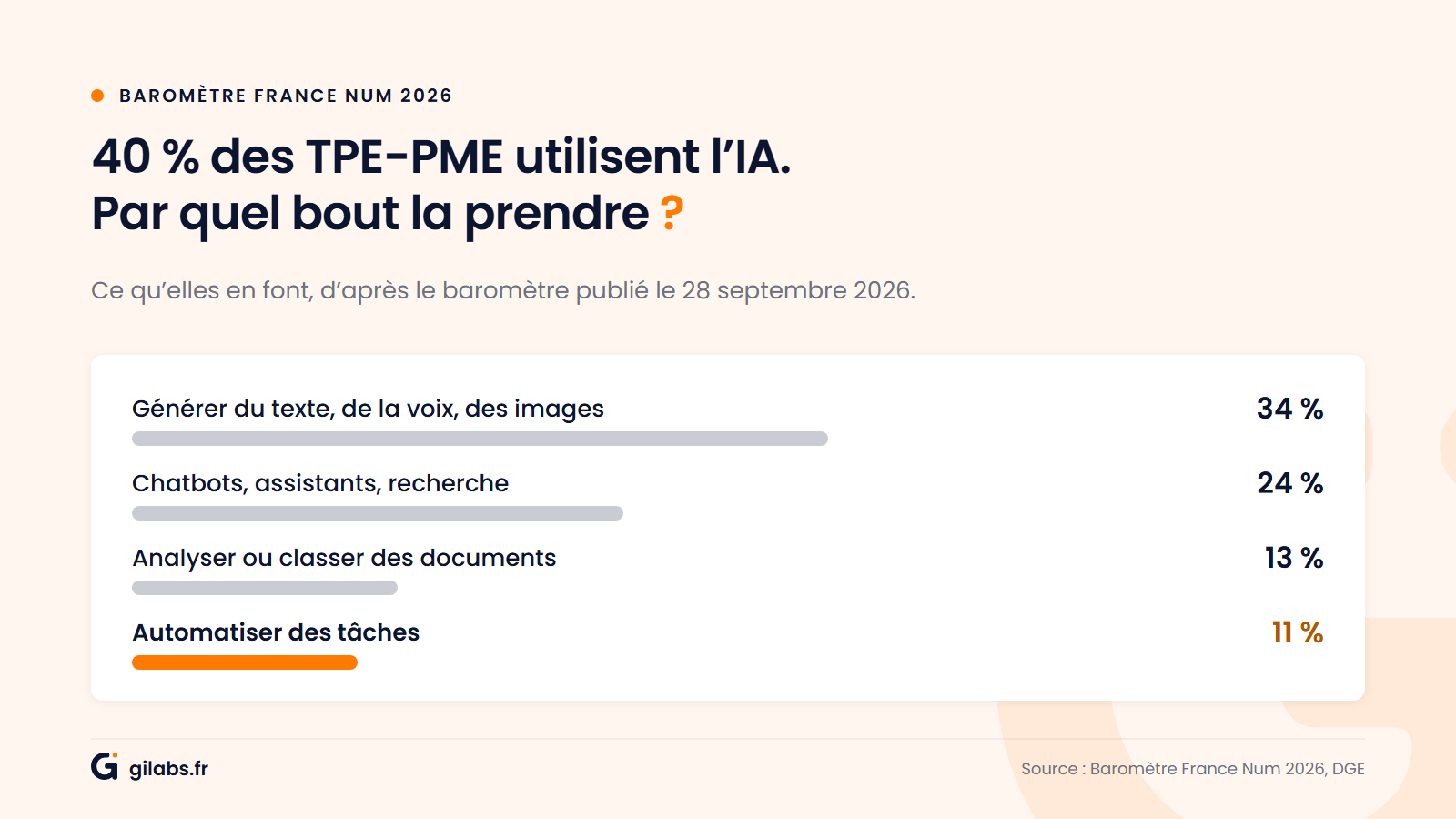
The more instructive figure sits just below. Here is what those businesses do with AI:
| Reported use | Share of businesses | Change over one year |
|---|---|---|
| Generating text, voice or images | 34% | +12 points |
| Chatbots, assistants, information search | 24% | +10 points |
| Analysing or classifying documents | 13% | +7 points |
| Automating tasks | 11% | +6 points |
Three times as many businesses write with AI as automate a task with it.
Two more figures complete the picture. Only 19% pay for an AI solution (32% among SMEs). And when business owners are asked about their digital projects for 2026-2027, AI is named by just 18% of them, far behind e-invoicing (39%).
Faster writing, same work
I do not read these numbers as a failure. Among the businesses that use AI, 68% say it has a positive impact on their activity. Drafting an email faster, summarising a document, preparing a tender response: the gain is real for the person using it.
But look at where that gain sits. A text produced faster is time saved on an individual task. The quote still goes out after three rounds of back and forth. The order is still re-keyed into two systems. The file still waits for the same sign-off. The process has not moved.
That is what I observed with Copilot rolled out and nothing changing in the accounts: you shorten the time worked on one step, while the delay comes from the waiting time between steps.
Hence the position I hold: a company where everyone uses ChatGPT on their own has not started its AI transformation. It has equipped individuals. That is useful, and it is not the same thing.
The survey shows it in its own way. Usage has jumped, yet AI is a project for fewer than one owner in five. People use it without having decided what to do with it. That is exactly the sentence I heard that evening.
Where to start
Asking “where do we start” usually means looking for the right tool. Copilot or ChatGPT? An agent? An automation platform? Asked that way, the question has no answer, because the tool depends on what you want it to do.
The right end to pick it up from is the process that costs you the most today. Three questions are enough to open the discussion:
- Where is the same information keyed in twice? Every re-entry is a delay and a source of errors.
- Where are you waiting for someone? A sign-off, a signature, a reply: that is where the lead time hides.
- What depends on a single person? Whatever stops when they are on leave is a good candidate.
The method I apply has three steps: map, prioritise, then automate. First describe the process as it really runs, step by step. Then put a cost on each pain point, so that only the ones worth it get treated. Automate last, and not necessarily with AI: some pain points are solved by a form, a direct feed between two systems, or by removing a step nobody can justify any more.
It is the same order as in doing the process by hand before automating it, and it is what moves AI from an expense to an investment: a subscription is justified by usage, a project is justified by what it shifts in the accounts.
The takeaway
The survey describes businesses that adopted AI through the tool, because the tool was there, free and immediate. That is a fine introduction. It is not a starting point.
You do not start with AI. You start with what gets stuck.
Sources and references
- France Num 2026 survey: four in ten small businesses now use artificial intelligence (press release, 28 September 2026, in French) French Ministry of the Economy, Direction générale des Entreprises