The 30-Day AI Diagnostic: why I packaged my offer into five fixed deliverables
A fixed-scope package with five written deliverables, not an audit that stops at a report: why a packaged AI consulting offer gets decided faster than an open-ended conversation.
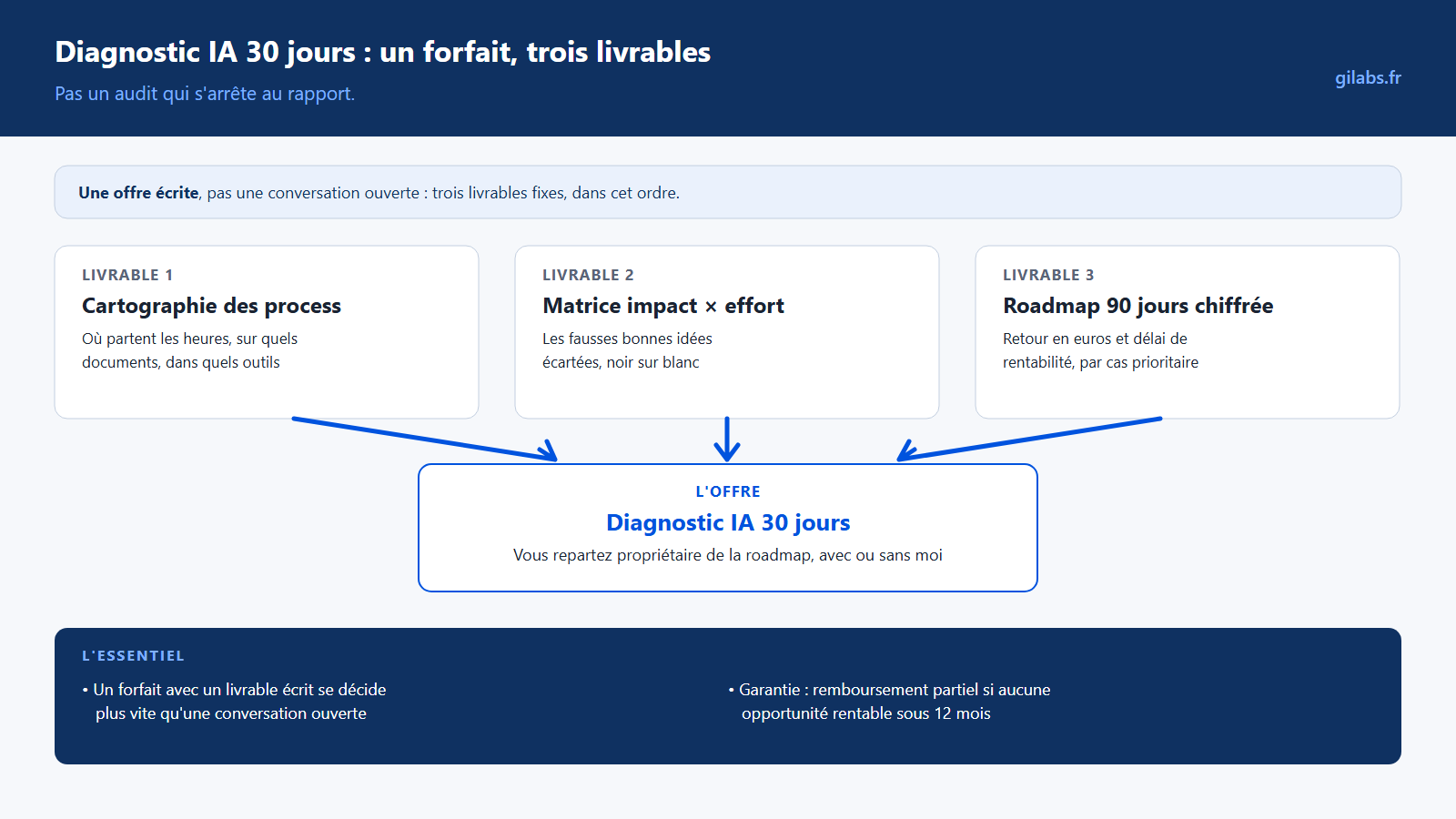
For a long time, my AI consulting offer fit into a conversation. Now it fits into a written scope. A prospect recently asked me: “what does this actually look like?” A fair question, and one a business owner should never have to ask after the first call.
Five fixed deliverables, in this order
The 30-Day AI Diagnostic is not an audit that ends in a report full of generic recommendations, the kind that gets closed after reading without anyone knowing where to start. It is a fixed-scope package with five deliverables.
Process mapping. Where the hours go, on which documents, in which tools. Most AI projects fail because they skip this step: a tool gets chosen before anyone has established which process it is actually meant to serve.
An impact × effort matrix. Every use case identified during mapping is positioned on these two axes. The false good ideas, the ones that sound compelling in a meeting but cost a lot for a marginal gain, get filtered out, and it’s written down in black and white.
The list of what you can stop doing. The steps nobody in the company can justify any more, costed. It is the only deliverable that pays off without buying anything: before automating a process, you remove what no longer belongs in it.
A costed 90-day roadmap. For each priority case, an expected return in euros and an estimated payback period in months. Not a vague promise about “AI’s potential”, a number a business owner can hold against their budget.
One brief per priority case. Scope, technical feasibility on your systems, prerequisites, cost estimate: enough to consult another provider or build it in house, with or without me.
Why package it this way
A fixed-scope offer with a written deliverable gets decided faster than an open-ended conversation. A business owner comparing several providers is not comparing hours of consulting, they are comparing concrete deliverables against a closed scope. The vagueness of a “we’ll figure it out based on your needs” offer is often exactly what stretches a decision out over several weeks. What the diagnostic asks of your teams is fixed the same way: one day of your time over thirty days.
And a documented investment decision carries more weight than a gut feeling about AI. A business owner who has seen, process by process, what pays off and what doesn’t, decides with actual information, rather than on a vendor’s promise or a colleague’s enthusiasm after a trade show.
What I don’t sell
I don’t sell an audit that stays vague. At the end of the 30 days, you own the roadmap outright, usable with me, with any other provider, or in-house if your team has the skills. Continuing with me on implementation is an option, never an obligation buried in the fine print.
That’s also why the diagnostic carries an explicit guarantee: if none of the identified opportunities reaches a return on investment within twelve months, I refund half the fee. A way of sharing the risk rather than putting it entirely on the client based on a report they can’t verify before paying.
This logic isn’t new to how I work: it’s the same one behind the .NET↔AI bridge, where I start from the premise that you map the existing system before deciding what to keep and what to rebuild. The 30-Day AI Diagnostic is simply the packaged version of that method, with a scope, a timeline, and a guarantee fixed in advance.
The full details of the offer, who it’s for and what it covers, are on the 30-Day AI Diagnostic page.
Updated on 30 September 2026: the offer published in July had three deliverables. It has five since the method removes unjustified steps before automating, and each priority case now gets its own brief.