Hiring a .NET developer and a data scientist at the same time: one need, not two
A company that hires a .NET developer and a data scientist at the same time is sending a clear signal: it does not yet know it is looking for a single person.
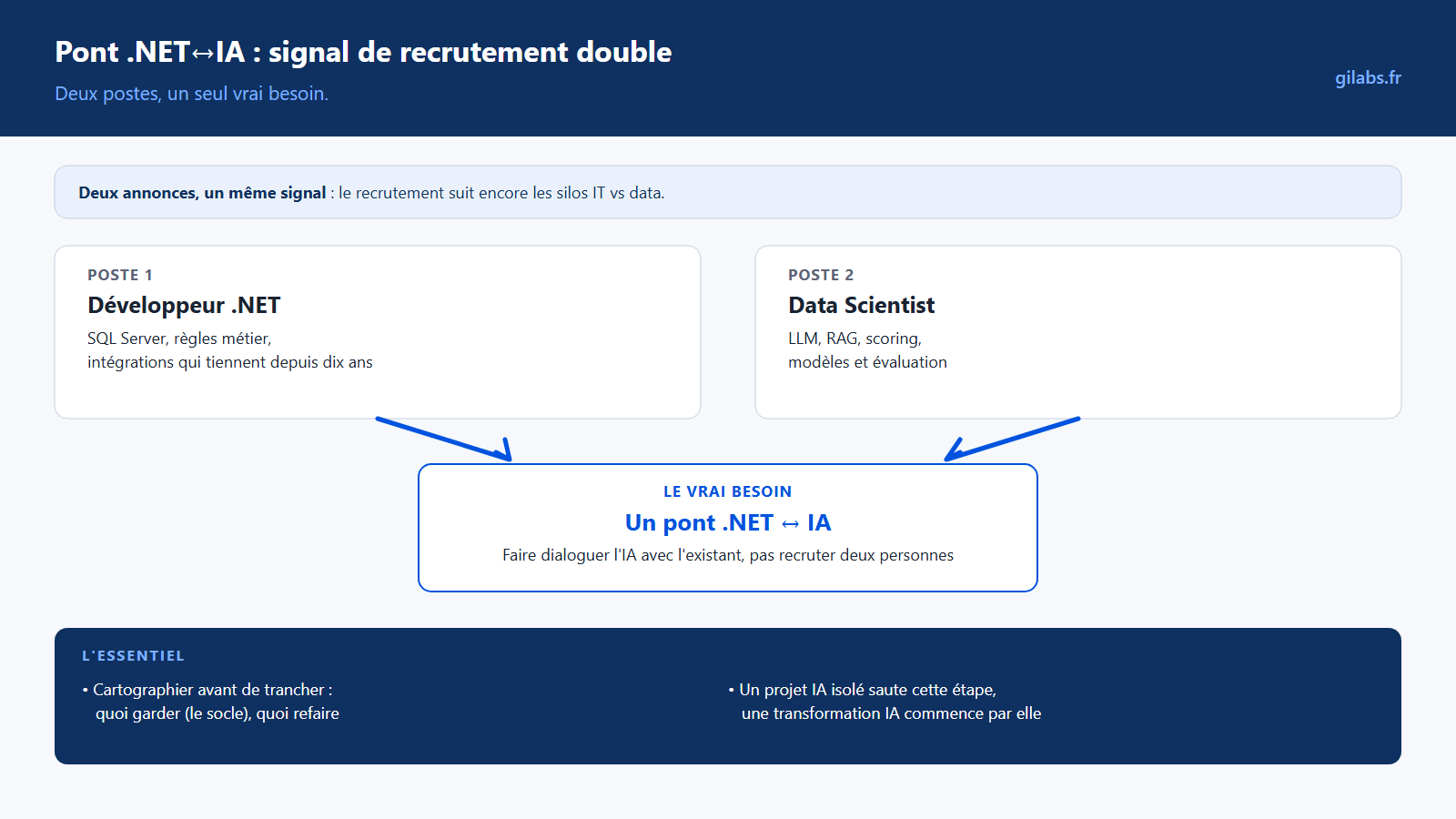
A company hiring a .NET developer and a data scientist at the same time is sending me a clear signal: it does not yet know it is looking for a single person. I keep seeing this pattern come up at prospects running on a Microsoft IT estate. Two roles, two separate hiring processes, for one real need: getting AI to talk to what already exists.
Two skill sets, rarely found in one person
The .NET developer knows the IT estate: the SQL Server database, the business rules accumulated over the years, the integrations that have held up for a decade that nobody dares touch.
The data scientist knows the models: large language models, RAG, scoring.
These two profiles rarely overlap in a single person. While the company tries to hire both separately, the application estate waits, and the hiring process often drags on for months.
What this changes in an AI transformation engagement
I never assume that everything existing must be rebuilt, nor the opposite assumption that nothing should be touched. The real question is to map things out before deciding: what, in the existing estate (Microsoft 365, SQL Server, business applications), should remain the foundation to build on, and what, on the contrary, is holding everything else back and deserves to be rethought.
The difference between an AI project and an AI transformation
This is exactly what distinguishes a successful AI transformation from an isolated AI project. The former always starts with this mapping of the existing system and the real processes. The latter jumps straight to a technical solution, without first checking whether it fits with what already exists.
A signal worth watching before the first call
If you spot, at a prospect or inside your own organization, a job posting looking separately for a .NET profile and a data science profile for the same AI project, it is often a sign that a mapping of the existing estate has not been done yet. That is precisely the starting point of a serious diagnostic: identifying what, in the .NET application estate, should carry the new AI capability, before even asking which profile to hire to implement it.