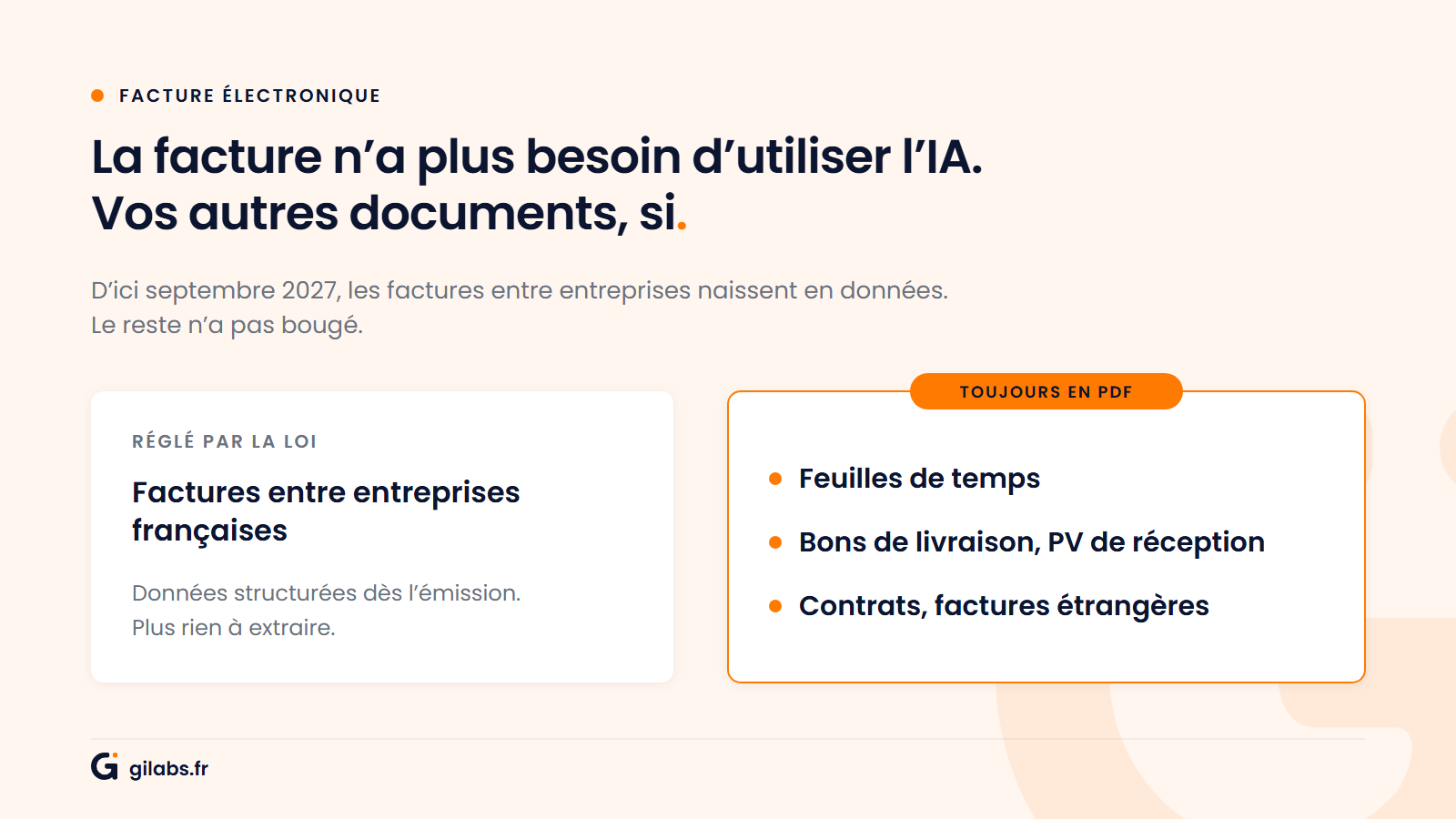
Invoices no longer need to use AI. Your other documents still do.
Since September, French invoices arrive as data: nothing left for an AI to read. Document extraction is not going away, it is changing targets.
I get AIs to read PDFs. One of my pipelines runs in production in an industrial setting: hundreds of paper timesheets, scanned every month, read by an extraction engine, checked by a human, then imported into the business database. I described how it works in this production write-up.
Since 1 September, invoices in France arrive as data. So the question deserves a straight answer: is this the end of that line of work?
No. But it has just changed targets.
What the reform actually changed
A French e-invoice is not a PDF sent by email. It is an invoice that travels through an approved platform, as structured data.
| Obligation | 1 September 2026 | 1 September 2027 |
|---|---|---|
| Receive electronic invoices | All companies | All companies |
| Issue electronic invoices | Large companies and mid-caps | SMEs and micro-businesses |
The accepted formats (Factur-X, UBL, CII) carry the invoice data in a form that software reads directly: amounts, VAT rates, dates, purchase order number. Factur-X keeps a PDF that a person can read, but that PDF is now only a view. Your software reads the data.
For document extraction, the consequence is mechanical. The supplier invoice is the use case everyone quotes first when they talk about getting an AI to read documents. An invoice born as data has nothing left to extract.
The switch is gradual. Invoices from your large and mid-cap suppliers have arrived as data since September. Those from your SME suppliers will follow in September 2027. Buying an invoice-reading tool today means investing in a tool whose main purpose disappears within a year.
What still arrives as a PDF
The law has structured invoices between VAT-registered companies in France. It has touched nothing else:
- timesheets, filled in by hand or in a spreadsheet, then printed, signed and scanned. That is exactly what my pipeline reads.
- delivery notes and acceptance reports, signed on a loading dock or a building site.
- contracts and their amendments.
- invoices from foreign suppliers, which stay outside the scope of the reform.
- bank statements, expense receipts, letters from the tax office.
Here is the paradox. The invoice now arrives clean, as data. But the document your teams check it against, the delivery note proving the goods arrived, the acceptance report proving the service was delivered, is still a scan. Matching order, delivery and invoice still goes through someone comparing two screens.
That is where document extraction still has real work to do. For an accounting firm, I went through what this shift changes in this guide.
Extraction is a patch
This is my line of work, and I will say it anyway: extracting data from a PDF is a patch.
Take a timesheet. The hours existed as data the moment someone wrote them down. They were printed, signed, scanned. Then an AI is asked to rebuild what already existed, with an error rate to monitor and a person to validate. Every scanned document is a piece of data that was degraded before you paid to repair it.
The reform shows the right order: data first, the document second, as a mere view for people. It is the same reasoning as getting the data foundation right before AI: the best data is the data that is born clean.
In practice, the question to ask for every re-keyed document is simple: who produces it?
- If it comes from outside (a foreign supplier, a customer, a subcontractor), you do not control its format. Extraction is the right answer, with human review and a correction loop. That is what keeps a pipeline running in production.
- If your own teams produce it, AI is not the first lever. A form at the point of entry, an app on the site, a direct feed between two systems often cost less than an AI that rereads, every month, what you printed yourselves.
It is one of the first sorts I run in a diagnostic: the list of re-keyed documents, and for each one, whether to extract it or remove it.
The takeaway
E-invoicing does not kill document extraction. It takes away its easiest example, and it is a reminder of what extraction is: a bridge between a paper world and an information system, useful for as long as that paper world exists.
The best extraction is the one you no longer have to do.
Sources and references
- Electronic invoicing: timetable of obligations (page updated 27 February 2026) Service-Public.fr
- Electronic invoicing and approved platforms Direction générale des Finances publiques