"We already have Copilot, why would we need you?": the question worth answering
The number-one objection from leaders running on Microsoft. Three things a Copilot license does not buy you, and the real question to ask before answering it.
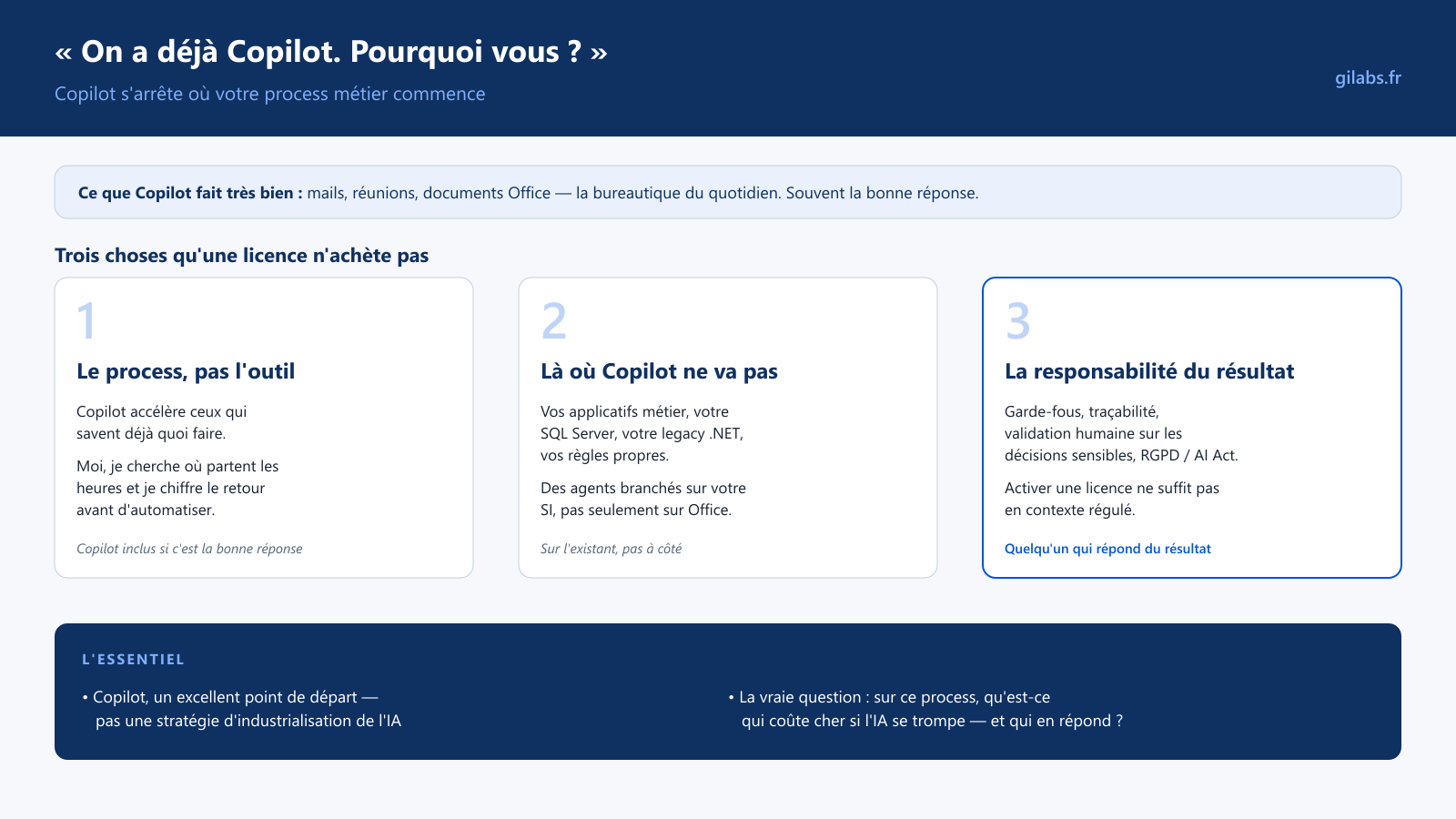
“We already have Microsoft Copilot. Why would we need you?” This is the first question most leaders running on Microsoft ask me. And the best answer is not “instead of Copilot.”
Copilot is a genuinely good tool. It drafts emails, summarizes meetings, speeds up Office document production. For day-to-day office work, it is often the right answer, and I tell clients so directly when that is the case. The issue is not Copilot: it is that an assistant built into Office does not touch where a company’s hours actually go.
Three things a license does not buy you
The process, not the tool. Copilot speeds up people who already know exactly what to do. Before automating anything, I look at where the hours go in a given process, and cost out the possible return. Sometimes the answer really is Copilot. Often, it is only a small part of it.
What Copilot cannot see. Your line-of-business applications, your SQL Server database, your .NET legacy, the rules specific to your business. Copilot reads your emails and Office files; it does not reach into your information system. That is exactly where custom-built agents come in, wired into what already exists, not bolted on next to it.
Accountability for the outcome. Guardrails, traceability, human validation on sensitive decisions, GDPR and AI Act compliance. In a regulated context, switching on a license is not enough: someone has to be accountable for what the system produces.
The real question to ask
It is not “Copilot or a custom agent?” It is: on this specific process, what does it cost if the AI gets it wrong, and who is accountable for that?
Copilot is an excellent starting point. On its own, it is not a strategy for industrializing AI.
Where the real answer starts
Answering this objection seriously means starting from the business process, not the license. That is exactly what a diagnostic is for: mapping the processes that cost the most, costing out the possible return, and pinpointing where a custom agent delivers value Copilot does not.